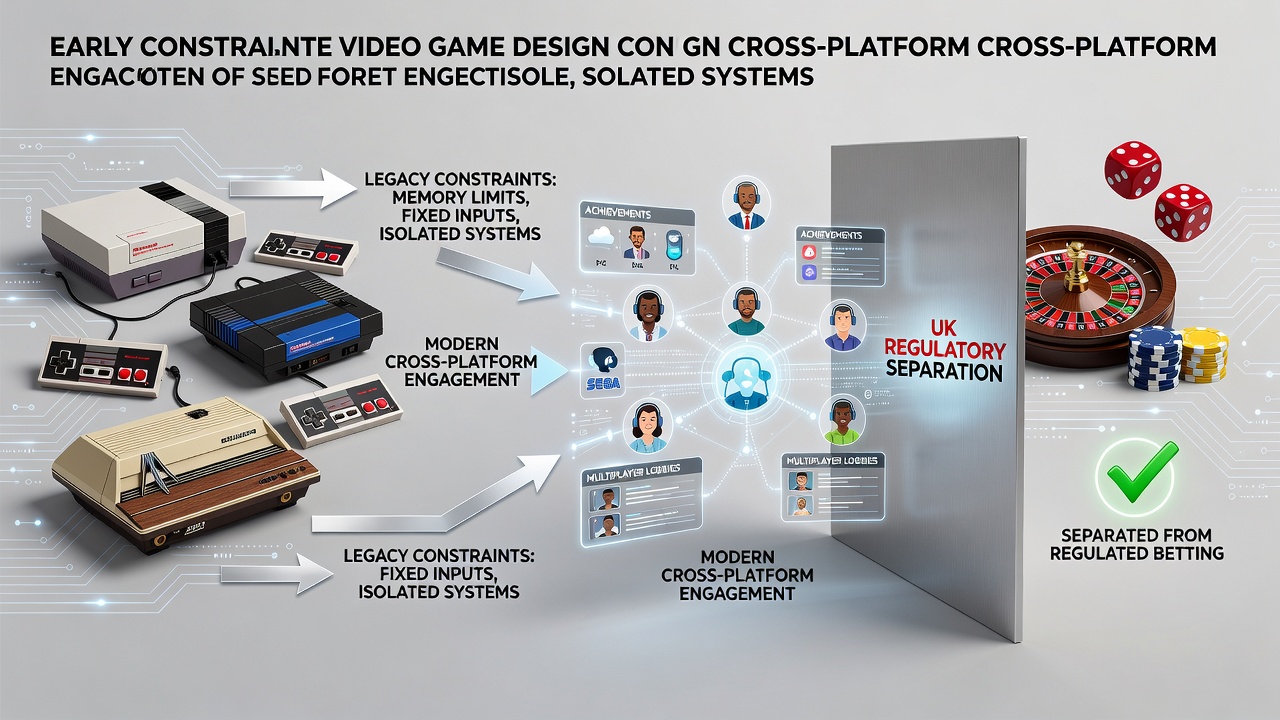
How Early Console Design Constraints Continue Shaping Cross-Platform Engagement Patterns While Maintaining Separations From Regulated Betting Activities Among British Players
Early console architectures imposed strict limits on memory, processing cycles and storage that forced developers to create compact game loops, predictable progression systems and minimalistic interfaces, patterns that persist in contemporary cross-platform titles even as hardware capabilities expanded dramatically.
Hardware Limitations From The 1980s And 1990s
Systems such as the Nintendo Entertainment System operated with roughly 2 kilobytes of RAM while the Sega Genesis managed 64 kilobytes, constraints that required programmers to reuse graphical tiles, limit enemy variety and structure levels around short repeatable segments rather than expansive worlds, according to archival technical documentation preserved by the Computer History Museum. These restrictions produced engagement rhythms built around brief concentrated sessions that players completed in single sittings, rhythms that carried forward when studios began targeting simultaneous releases on consoles, personal computers and mobile devices.
Design teams learned to prioritise modular asset pipelines and server-authoritative matchmaking so that a single codebase could scale across disparate platforms without violating the original performance envelopes, and this modular approach remains visible in titles that synchronise progress between handheld and living-room hardware in October 2026.
Cross-Platform Patterns Emerging From Legacy Constraints
Because early consoles could not sustain long continuous loads without cartridge swaps or lengthy disc reads, developers favoured checkpoint systems and discrete mission structures that translated naturally to mobile play sessions interrupted by commutes or notifications. Data compiled by the Entertainment Software Association shows that average session lengths on hybrid titles still cluster around the twelve-to-fifteen-minute mark first established by cartridge-era design, even when players use high-bandwidth broadband connections on modern consoles.
Those same constraints encouraged deterministic physics and rule sets that avoid random number generators tied to real-money outcomes, thereby preserving clear separation between interactive entertainment products and regulated betting activities under British licensing frameworks. Developers continue to implement deterministic logic because it reduces testing overhead across device types while satisfying platform holders that demand consistent behaviour regardless of hardware generation.

Regulatory Distinctions In The British Market
British players encounter statutory definitions that classify products as games of skill when outcomes depend primarily on player decisions rather than chance, a distinction reinforced by the separation of gaming software from gambling licences overseen by authorities outside the United Kingdom Gambling Commission. Industry reports from the Interactive Software Federation of Europe indicate that studios routinely audit randomisation features to ensure they affect cosmetic progression only, thereby avoiding classification as betting products when titles launch simultaneously on consoles, PCs and smartphones.
Cross-border regulatory shifts in neighbouring European markets have prompted additional documentation requirements, yet British engagement data collected through device telemetry shows that players maintain consistent play patterns across platforms without migrating toward real-money mechanics. Observers note that the legacy emphasis on skill-based progression provides a natural buffer that keeps most cross-platform experiences outside the scope of financial wagering regulations.
Current Engagement Metrics And Platform Behaviours
Telemetry gathered in October 2026 reveals that British users of cross-platform titles spend comparable aggregate hours on stationary consoles and portable devices, yet the distribution of those hours follows the short-burst model inherited from cartridge limitations. Researchers at the University of Melbourne documented similar session fragmentation in a multi-year study of European players, finding that deterministic reward schedules originally dictated by memory ceilings continue to correlate with voluntary spending caps on in-game cosmetic items.
Platform certification processes further embed these patterns because certification suites test for frame-rate stability and load-time consistency that trace directly back to the performance budgets of 1990s hardware. Developers therefore retain lightweight user interfaces and predictable save systems that function identically whether the player connects from a living-room television or a commuter train.
Conclusion
Legacy console constraints established compact engagement loops, deterministic mechanics and modular code structures that still govern cross-platform releases while reinforcing regulatory boundaries that distinguish skill-driven entertainment from regulated betting activities for British participants. Industry telemetry and academic analyses confirm that these historical parameters continue to shape session lengths, interface design and monetisation approaches without overlap into financial wagering categories.