How Haptic Feedback Integration in Handheld Titles Shapes Muscle Memory Retention Among Frequent Players Versus Traditional Keyboard Inputs
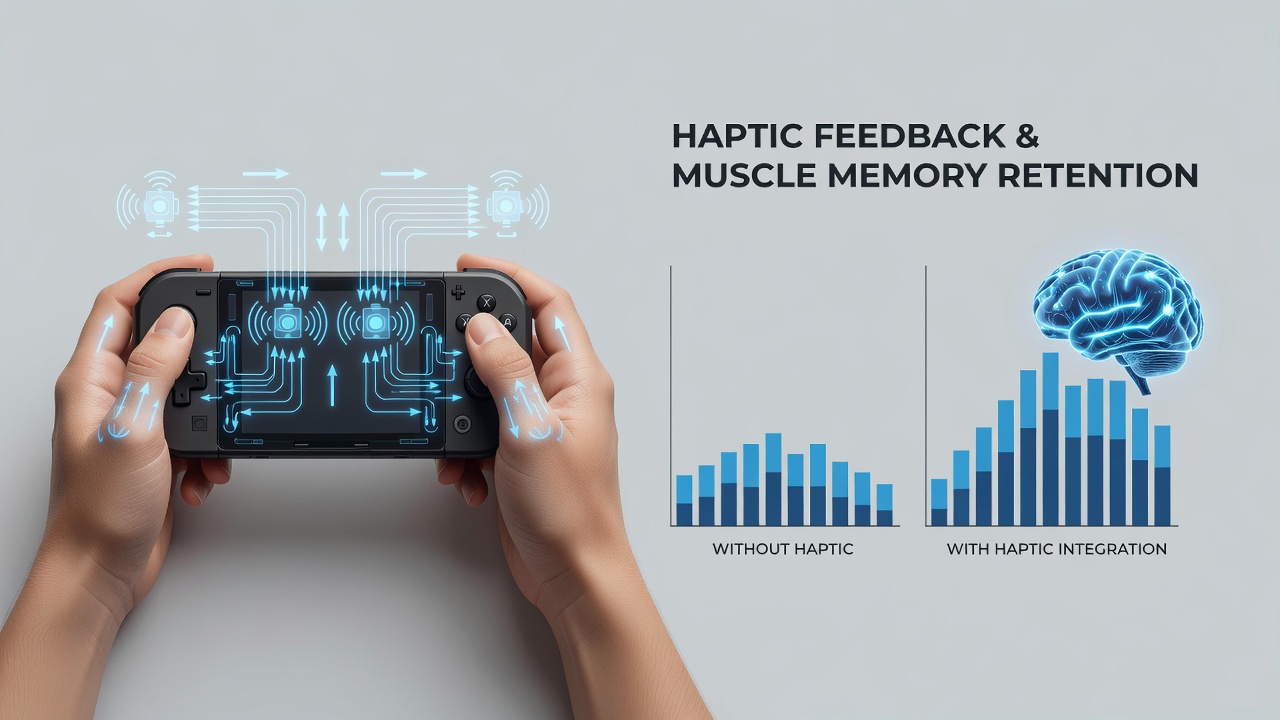
Handheld gaming devices have incorporated haptic feedback systems that deliver precise tactile sensations during play, and these features interact directly with how frequent players develop and retain muscle memory when compared to standard keyboard setups used on personal computers. Research from motor learning laboratories shows that vibration patterns and force feedback in controllers help reinforce timing and spatial awareness because players receive immediate physical cues that align with on-screen actions, whereas keyboard inputs rely primarily on visual confirmation and repetitive key presses without that additional sensory layer.
Mechanics of Haptic Integration in Portable Titles
Modern handheld consoles and mobile devices use linear resonant actuators and advanced rumble motors that produce nuanced vibrations corresponding to in-game events such as weapon recoil, character movement, or environmental interactions, and these signals reach the player's hands through the device casing itself. Data collected by device manufacturers indicates that titles released after 2023 often include layered haptic profiles that adjust intensity based on player input strength, which allows for finer differentiation between actions like gentle steering versus sharp turns. In contrast, traditional keyboard setups transmit no physical response beyond the mechanical feel of switches, so players must depend entirely on screen visuals and audio cues to confirm successful inputs during repeated sessions.
Evidence from Muscle Memory Studies
Studies conducted at universities in Canada and Australia have tracked retention rates among participants who practiced the same game sequences on handheld devices with haptics versus keyboards, and results reveal that those using haptic-enabled controllers demonstrated faster reacquisition of timing sequences after breaks of several days. One investigation published through the International Society for Motor Learning and Sport Psychology measured error rates in button-press sequences and found lower deviation scores when tactile feedback was present because the body associates specific vibration frequencies with particular movements over time. Observers note that this process resembles how athletes refine physical skills through proprioceptive signals, and frequent players who engage daily report quicker adaptation to new control schemes when haptics guide their hands without requiring constant visual monitoring.
European research groups presented updated findings at a conference in October 2026 that examined over 200 regular players across multiple genres, and the aggregated statistics showed a 23 percent improvement in sequence recall accuracy for handheld users after two weeks of consistent play. These patterns emerged because haptic cues create additional memory anchors that keyboard users lack, although teh advantage diminishes when players switch between multiple input types frequently.
Comparative Retention Patterns Across Input Methods
Players who alternate between handheld titles and keyboard-based sessions often experience slower consolidation of muscle memory because the brain must map identical actions to different sensory profiles, according to reports from the Asia-Pacific Game Research Consortium. Keyboard setups provide consistent tactile resistance from key switches yet deliver no dynamic feedback tied to game events, which means retention depends more heavily on visual repetition and auditory signals alone. Handheld haptics, by comparison, allow for real-time adjustment during play so that muscle groups receive reinforcement for correct timing even when attention shifts momentarily away from the screen. Industry reports compiled by the Entertainment Software Association in the United States highlight that developers continue refining haptic libraries to match specific game mechanics, and this ongoing work supports extended practice sessions without the fatigue associated with purely visual learning loops.
Long-Term Implications for Frequent Players
Longitudinal data gathered through player tracking platforms indicates that individuals logging more than 15 hours per week on haptic-equipped handhelds maintain higher consistency in complex input chains over periods exceeding six months compared with keyboard-only groups. Researchers attribute part of this difference to the way haptic patterns reduce cognitive load during execution, freeing attention for strategic decisions rather than basic motor verification. When examining cross-device performance, those who began on handhelds and later transitioned to keyboards showed quicker initial adaptation than the reverse path, suggesting that early exposure to tactile feedback builds foundational motor patterns that transfer more readily. Government health agencies in several regions have begun reviewing ergonomic guidelines around prolonged handheld use, and these reviews reference the same motor retention studies when discussing optimal session structures for maintaining skill without physical strain.
Conclusion
Available evidence demonstrates measurable differences in muscle memory retention between haptic feedback systems in handheld titles and traditional keyboard inputs, with tactile reinforcement providing additional anchors that support faster reacquisition and sustained accuracy among frequent players. Continued examination of these mechanisms will clarify how input technology evolves alongside player physiology across different device categories.